Pole Mounted Transformer: Technical Guide
How a Pole Mounted Transformer Works
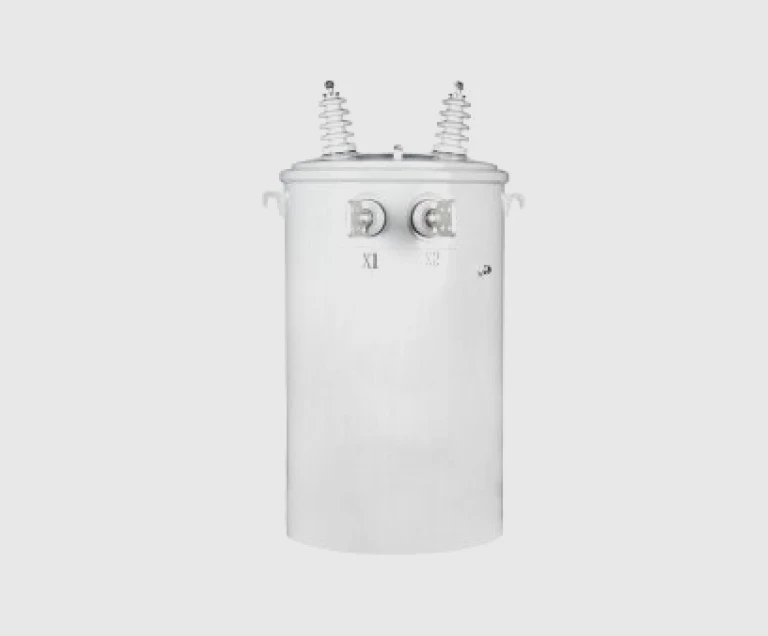
A pole mounted transformer operates on the same electromagnetic induction principle as any other transformer. Medium-voltage power on the overhead primary line — typically 11, 22, or 33 kV — feeds into the HV bushing and across the primary winding wound on a silicon steel core. The alternating current generates magnetic flux in the core, which induces a lower voltage in the secondary winding, available at the LV bushings for connection to the consumer service drop.
What makes a pole mounted transformer specifically suited to overhead distribution is its compact, sealed construction. The entire core-and-coil assembly sits inside a welded steel tank filled with mineral insulating oil. The tank has no breather and never opens to the atmosphere, so the oil stays clean throughout the unit's service life. Mounting brackets are welded directly to the tank for attachment to the pole, eliminating the foundation work required for a pad-mounted unit. ONAN cooling — heat carried by oil convection from windings to tank wall, then released to ambient air — handles full load with no fans or pumps, which means no auxiliary power and no moving parts to fail.
Single-Phase vs Three-Phase Pole Mounted Configurations
Pole mounted transformers come in two electrical configurations matched to the distribution network they connect to.
Single-phase pole mounted transformers are the standard for residential overhead distribution in North America and a growing choice in parts of Asia, Africa, and Latin America where extending three-phase service is uneconomical. The primary winding connects either line-to-ground (with one HV bushing) on a wye-connected primary system, or line-to-line (with two HV bushings) on a delta-connected primary. The secondary is typically split-phase 240/120 V for North American applications or 230 V for international markets, feeding several houses through individual service drops. Capacities run from 10 kVA up to 500 kVA, with 25, 37.5, 50, 100, and 167 kVA being the most common sizes.
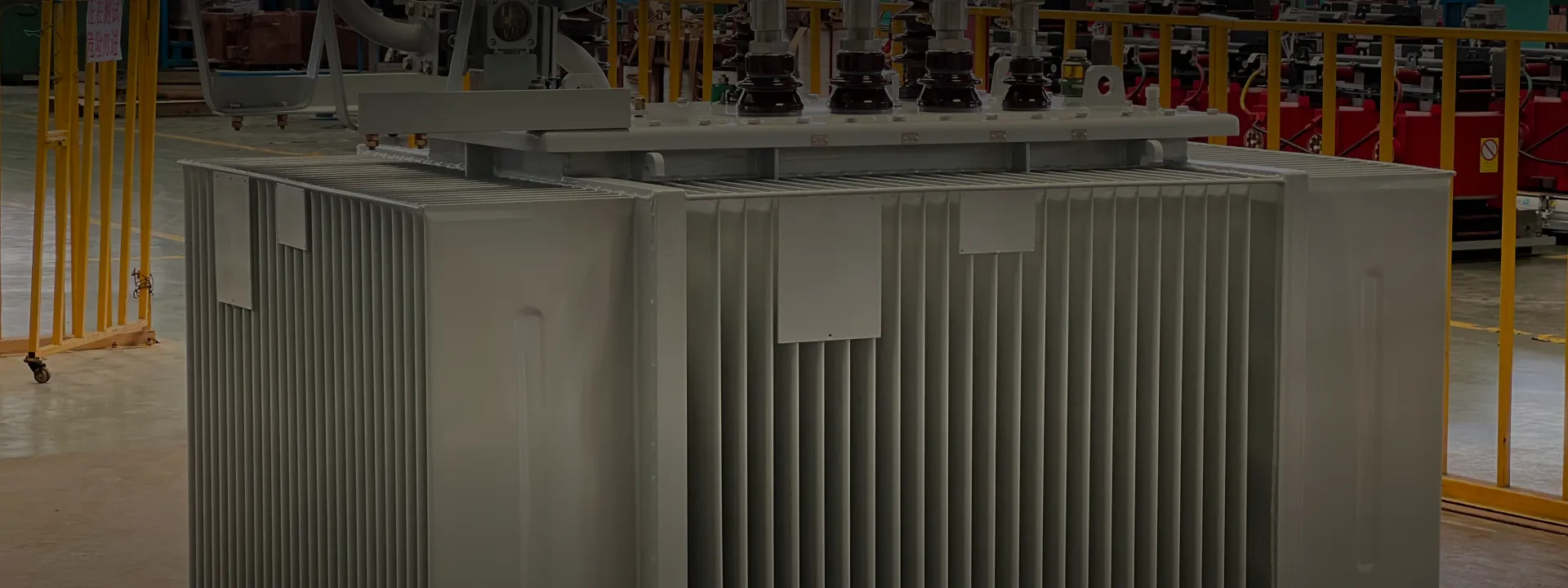
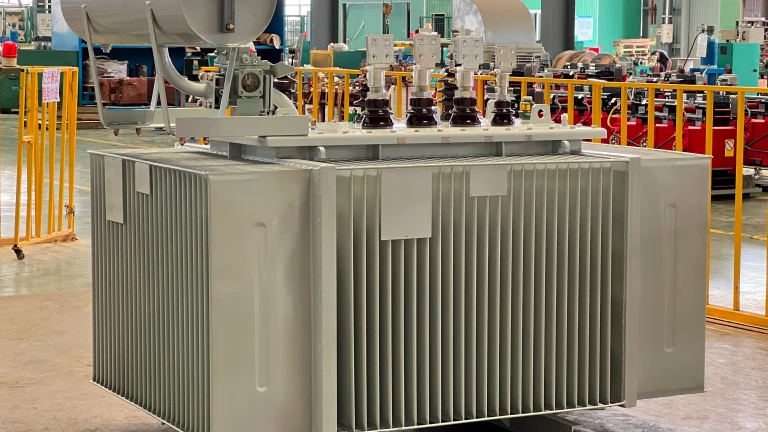
Three-phase pole mounted transformers supply commercial buildings, three-phase motor loads, and rural networks where three-phase service has been extended to the consumer. The primary side has three HV bushings, connected to all three overhead primary conductors. The secondary side has four LV bushings — three phases plus neutral — supplying three-phase loads at 0.4 kV (50 Hz markets) or 0.48 kV (60 Hz markets). Standard vector group is Dyn11; Yyn0 is also common. Standard pole platform mounting supports capacities up to 500 kVA; H-frame mounting between two poles extends the capacity range to 1,000 kVA.
Mounting Methods — Direct Pole, Platform, and H-Frame
Pole mounted transformers attach to the pole in one of three ways, chosen by transformer weight and the utility's standard pole-line construction.
• Direct pole mount — the most common method. The transformer is bolted directly to the pole using a pair of mounting brackets welded to the tank, with bolts or banding straps clamping the unit against the pole. Suitable for single-phase units up to about 100 kVA, and small three-phase units up to about 75 kVA. Quickest installation; no separate platform required.
• Platform mount — a horizontal steel platform is attached to the pole below the cross-arm, with the transformer bolted to the platform. Used for larger single-phase units (up to 500 kVA) and three-phase units up to roughly 500 kVA. Provides a stable base for heavier units and easier access for surge arresters and fuse cutouts.
• H-frame mount — two parallel poles are connected by horizontal cross-members, with the transformer mounted between them. Used for the largest three-phase pole mounted units (up to 1,000 kVA) and where ground clearance or stability requirements exceed what a single pole can provide. More expensive than single-pole mounting but distributes the weight across two structures.
Protection — Surge Arresters, Fuses, and Wildlife Guards
A pole mounted transformer is exposed to lightning strikes, switching surges, and direct contact from birds and small animals. Three categories of accessory protect the transformer and the network.
Lightning surge arresters are installed on the cross-arm next to each HV bushing. When an overvoltage surge appears on the primary line, the arrester conducts the surge current to ground before it can damage the transformer's insulation. Arresters are sized to the system's BIL (basic insulation level) and to the maximum continuous operating voltage of the network. Polymer-housed arresters have replaced porcelain in most new installations.
Fuse cutouts — sometimes called dropout fuses or expulsion fuses — provide short-circuit protection on the HV side. A fault on the secondary side or inside the transformer pulls high current through the fuse element, which melts and physically drops the fuse holder open, visibly isolating the faulty transformer from the network. The dropped fuse is easy to spot from the ground, simplifying utility patrol and replacement.
Wildlife guards — bushing boots, animal-shield disks, and cross-arm covers — prevent birds and squirrels from bridging energized terminals to ground or to other phases. Wildlife contact is a leading cause of distribution-line outages in many regions; basic guards are inexpensive insurance against repeat faults at the same pole.
How to Specify a Pole Mounted Transformer
At the quotation stage, confirm the following parameters. Anything you cannot specify, our engineering team can derive from your single-line diagram and utility specification.
1. Phase configuration. Single-phase for residential and small commercial loads; three-phase for commercial buildings, three-phase motors, and larger services.
2. Rated capacity (kVA). Total connected load × diversity factor + future growth allowance.
3. Rated voltages. Primary (commonly 11, 22, or 33 kV on 50 Hz systems; 7.2, 12.47, or 24.94 kV on 60 Hz systems) and secondary (commonly 0.4 kV for three-phase, 240/120 V split-phase for single-phase North American).
4. Vector group (three-phase only). Dyn11 is the international default; Yyn0 is also common.
5. Tap range. ±5% in two steps of 2.5% is standard for off-circuit tap changing.
6. Bushing arrangement. IEC pattern for 50 Hz networks; ANSI/IEEE pattern for North American 60 Hz networks.
7. Mounting method. Direct pole mount for smaller units; platform mount for medium; H-frame for largest three-phase units.
8. Accessories. Lightning surge arresters, fuse cutouts, wildlife guards, secondary terminal box, secondary breaker — supplied as part of a complete kit on request.
9. Site conditions. Altitude (derating above 1,000 m), coastal/tropical environment (enhanced anti-corrosion paint), extreme temperature range, pollution level.
Maintenance and Service Life
A hermetically sealed pole mounted transformer is one of the lowest-maintenance pieces of equipment in a utility distribution network. Because the tank never breathes, there is no oil sampling routine, no breather to service, and no gaskets that age. Maintenance reduces to:
• Visual inspection during pole-line patrol — check for oil leaks at bushings, physical damage to tank, missing or damaged surge arresters, and wildlife contact damage.
• Infrared thermography — periodic thermal scan to identify hot bushing terminations, loose connections, or overloaded units.
• Surge arrester inspection — confirm arresters have not failed (visible disk discoloration on polymer types).
• Bushing cleaning — wipe contamination from porcelain bushings in heavy-pollution environments to prevent flashover.
• Replacement of failed fuse cutouts after fault clearing.
With this basic patrol routine, a properly specified pole mounted transformer reliably delivers 25 to 30 years of service. Premature failures are almost always traceable to one of three causes: sustained overloading from undersized initial capacity, lightning damage from missing or undersized surge arresters, or tank corrosion in unprotected coastal and tropical environments.